We Decorate Our Offices. Why Not Our Online Meetings?
The research behind more welcoming rooms and office spaces: how thoughtful design in physical and virtual workplaces can shape the way people feel and connect.
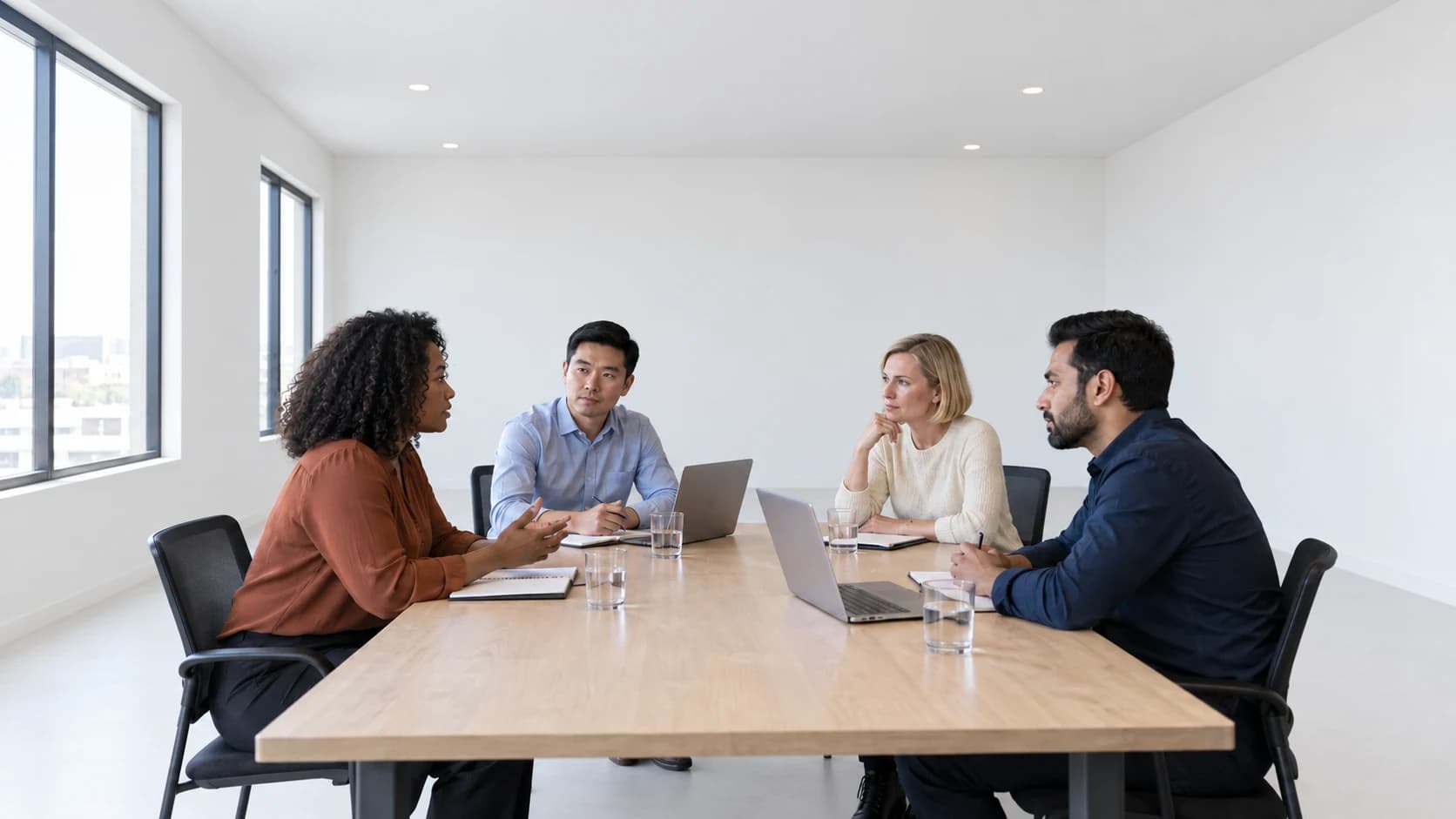
Imagine walking into your weekly team meeting. Your colleagues are there. The table is ready. The room is a simple white box: white walls, a white ceiling, and a clean white floor. There is no artwork, no greenery, and nothing that reflects the people who use it. Everything is in place for a conversation. What would make it feel more welcoming?
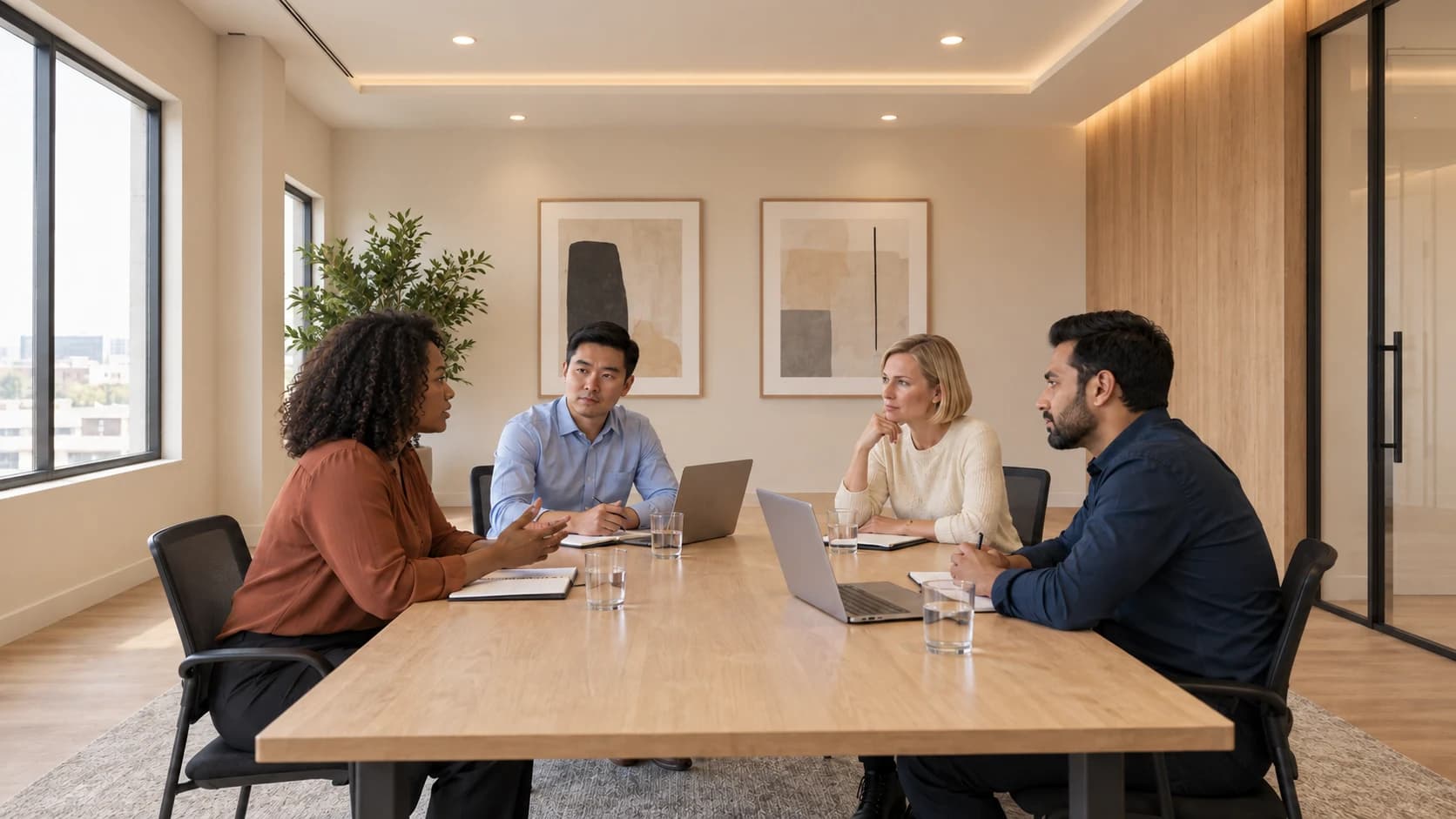
Now look at the second image. The same people sit around the same table, with the same work in front of them. The room has warm light, artwork, natural textures, and a little greenery. Before a word is spoken, there is a different welcome.
That is why we decorate offices. We care about what it feels like to spend time in them. A functional room gives people a place to meet. A few thoughtful choices can help them feel welcome there.
Physical offices: what an undecorated room leaves out
This intuition has been tested. In two experiments involving 112 and 47 participants, Craig Knight and S. Alexander Haslam compared bare offices with offices decorated with plants and art. The enriched rooms produced better well-being and productivity outcomes. Giving people a say in the decoration improved outcomes further; overriding their choices weakened those benefits.
A later study moved into commercial workplaces. Across three field experiments in the UK and the Netherlands, adding plants improved outcomes including workplace satisfaction and, in a controlled task comparison, productivity. Two experiments followed employees over weeks or months. The effects varied by measure, so the useful conclusion is that a stripped-back office is not automatically the best place to work.
Personal meaning matters, too. A 2013 workplace study found that personalization buffered the association between low perceived privacy and emotional exhaustion. In a separate simulated team-work experiment, groups performed better in decorated rooms containing team-identity cues than in undecorated rooms. Both their own team’s and a rival team’s decorations helped, so this was not proof that matching branding alone caused the benefit.
The broader evidence also points to comfort and choice. A systematic review of 50 studies found positive relationships between well-being and daylight, greenery, and individual control, while noise and some open office layouts were associated with poorer outcomes. Design includes the practical experience of being in a room, as well as its appearance.
People read the room as a signal about the organization
A 2025 study of workplace images in job postings offers a particularly close connection to the idea of feeling valued. Across three experiments, nature-inspired workplace imagery increased organizational attraction. Perceptions of the organization as warmer and more communal helped explain that attraction. These were impressions from images, rather than measurements of how existing employees were actually treated.
Similarly, research published in 2022 found that creative workspace design increased applicants’ job-choice intentions, partly through perceptions of the company’s creativity and ability to innovate. Together, these studies support a practical point: people use the setting to interpret what an organization stands for.
Virtual offices are places people respond to, too
Researchers have also studied the experience of spending time in virtual offices. A randomized crossover study with 30 participants found lower physiological stress indicators and higher creativity scores in virtual offices with nature-inspired elements. A separate 39-participant experiment found better memory and creativity performance, along with more positive feelings, when plants were added to an otherwise identical virtual office.
Shared settings matter as well. In an eight-week virtual-reality study with 137 participants, more spacious environments were associated with greater enjoyment, feelings of restoration, and group cohesion. Outdoor settings also improved restoration and enjoyment compared with indoor ones. These headset-based studies are relevant to the design of virtual places, but their results cannot simply be assigned to a browser meeting room.
What the evidence gives us
Across these different settings, the environment can shape how people feel, how they experience an organization, and how they perform on some tasks. That is a sound reason to take meeting design seriously. It supports thoughtful choices about greenery, visual character, personal meaning, and the amount of stimulation.
The studies above did not test Faceport or demonstrate that a beautiful room makes every team feel valued. Physical offices, immersive virtual offices, and browser meeting rooms are different experiences. Our application of the research is to bring care to the shared setting, then listen to how the people using it respond.
Design the whole room around the people who use it
Start with the purpose of the space. A room for focused discussion, a workshop, and a team celebration can each have their own character. In a physical office, consider the light, seating, acoustics, and places to gather. Invite the people who spend time there to help choose the artwork, plants, and details that make it feel like their workplace.
Bring that same intention to a virtual office. Give the team a recognizable place to arrive, with meeting rooms that feel connected to the company and suited to the occasion. Consider the whole shared space: its sense of openness, colors, textures, and the way it frames the conversation. Keep people and shared work easy to see. The aim is a room the team feels comfortable returning to.
“It’s only an internal meeting” is a reason to care
Clients and candidates deserve a thoughtful welcome. So do the colleagues who show up every week. The Monday check-in, the project review, and the quick conversation with a manager are all part of what working at your company feels like.
Those everyday moments deserve attention precisely because they are familiar. Invite the team to help choose a setting. Give focused conversations a calm room, keep faces and shared work easy to see, and save more playful visuals for occasions that suit them. Someone may even smile when they arrive. That is a worthwhile thing to make room for.
Faceport sets the tone, the standard, and the meeting spirit
Faceport brings designed meeting environments and branded invitations to online gatherings. It gives you a way to carry the care you put into your physical workplace into the rooms your team shares digitally.
The tone is the welcome people encounter. The standard is the attention you bring to the occasion. The meeting spirit is the feeling you hope everyone shares: comfortable, valued, and pleased to be there. A thoughtful visual setting helps express that intention.
Start with your next ordinary meeting. Choose a space that feels right for the people and the conversation. Let the room say, “We’re glad you’re here.”
Good hosting still means a clear purpose, listening carefully, and respecting everyone’s time. A considered environment belongs alongside those habits.
Explore Faceport meeting spaces, or see how a digital headquarters can give your team a familiar place to come together.
References
- Knight & Haslam (2010). Lean, enriched, and empowered offices. Journal of Experimental Psychology: Applied.
- Nieuwenhuis et al. (2014). Green versus lean office space: three field experiments. Journal of Experimental Psychology: Applied.
- Laurence, Fried & Slowik (2013). Workspace privacy, personalization, and emotional exhaustion. Journal of Environmental Psychology.
- Greenaway et al. (2016). Spaces that signal identity improve workplace productivity. Journal of Personnel Psychology.
- Colenberg, Jylhä & Arkesteijn (2021; online 2020). Interior office space, health, and well-being: a review of 50 studies. Building Research & Information.
- Maier et al. (2022). Creative workspace design and organizational attractiveness. Journal of Environmental Psychology.
- Merriman et al. (2025). The signaling effect of biophilic job posts. Human Resource Management.
- Yin et al. (2019). Biophilic office design, stress, and cognition in virtual reality. Indoor Air.
- Mostajeran et al. (2023). Virtual plants, cognitive performance, and psychological well-being. Scientific Reports.
- Han et al. (2023). People, places, and time in shared virtual environments. Journal of Computer-Mediated Communication.
Faceport for Business
Give your team a room they’re glad to walk into.
Set a welcoming tone for the big occasions and the everyday conversations.
Explore meeting spaces